
The Card, the Set, the Man: Jackie Robinson 1948 Leaf #79 Rookie Card (PSA 7) to be Auctioned Live on Pristine Live! Elite
There are rare cards, and there are valuable cards. Then there are sports cards that represent a moment when history changed.
The 1948 Leaf #79 Jackie Robinson rookie card is one of those cards — maybe even the card that best fits this mold. Because when you hold this card, you’re holding a relic that was created during an era when Jackie Robinson’s story was still unfolding.
He broke the MLB color barrier in 1947, which had already earned him a permanent chapter in baseball history. But no one at the time knew just how significant his place in American history would become.
Along with its rarity and what some consider its high upside in the current card market, this makes his rookie card different from most others collectors spend their lives chasing. Cards like this don’t surface often, so when they do, they tend to draw attention from serious collectors, historians, and investors.
That’s why we’re excited to announce that Pristine Auction will offer collectors a rare opportunity to own a 1948 Leaf #79 Jackie Robinson rookie card, graded PSA 7, during a live online auction on Tuesday, March 31 at 8pm EST / 5pm PST.
Before that auction begins, though, it’s worth taking a closer look at the card itself, the set it came from, and why this particular piece has become one of the most respected and quietly sought-after cards in the entire hobby.
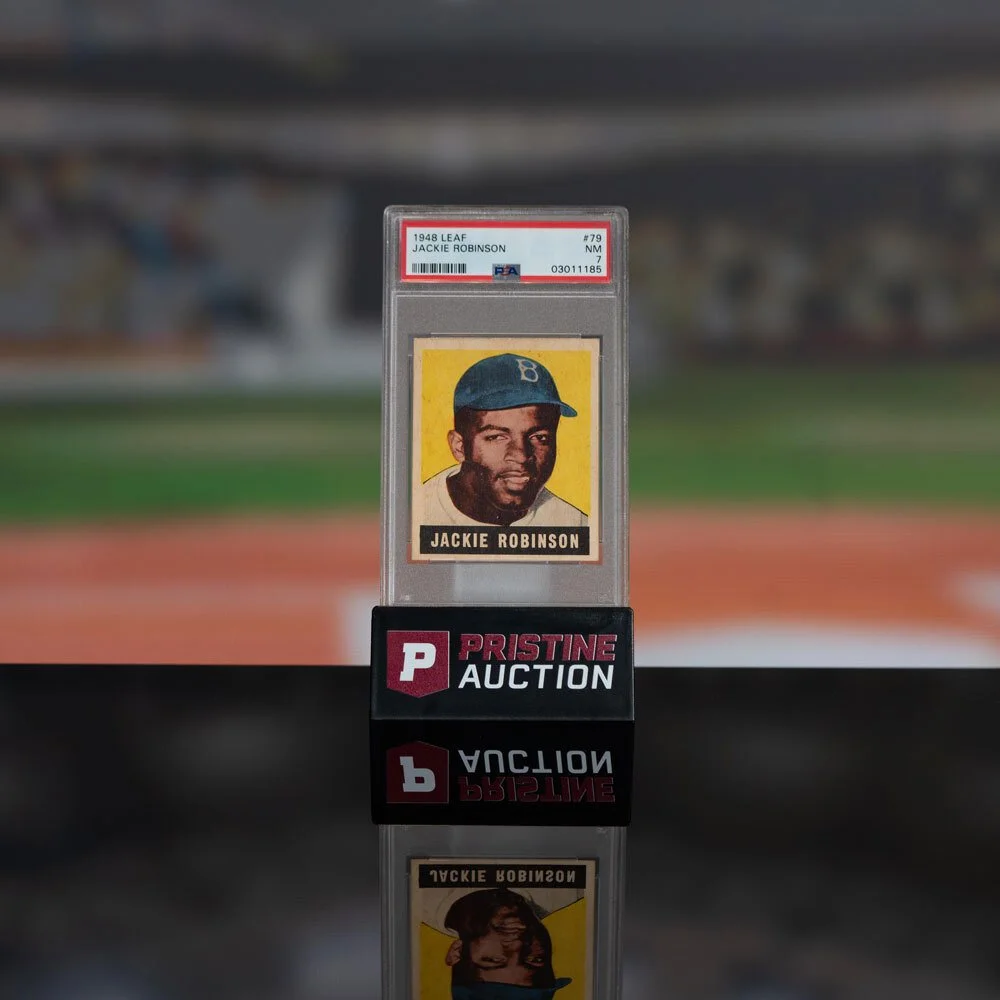
Get a sneak peek of the listing early!
Why Jackie Robinson Is One of the Most Important Figures in Sports History
With all apologies to Mickey Mantle, Muhammad Ali, and Michael Jordan, the main reason this card carries that weight it does is it depicts probably the most important person in American sports history.
Even non-sports fans know the Cliff Notes version of Jackie Robinson’s story. His breaking baseball’s color barrier during a tense and divided time in post-World War II American history … that’s pretty well-known.
What sometimes gets buried beneath the lead is how great of an athlete he actually was and how much he accomplished off the field.
Robinson was the 1949 National League MVP and finished his career with a .311 batting average. He stole home 19 times, won a batting title, and played second base with an aggressive, instinctive style that impacted how the position was played.
So, he wasn’t just a symbolic player who happened to be historically important. He was one of the best players in the league. But before committing to baseball, Robinson was one of the best all-around athletes competing in the country.
At UCLA, he became the first student to letter in four sports during a single season: baseball, basketball, football, and track. During the summer months, he won a few amateur titles in tennis, and then after college and WWII, he played semi-pro football before starting his Major League career.
Then after he retired from baseball, he became active in the Civil Rights Movement, spoke and wrote frequently about racial inequality, testified before Congress, and worked closely with Dr. Martin Luther King Jr. He also became the first Black vice president of a major American corporation when he joined Chock full o’Nuts.
Robinson’s life is filled with barrier-breaking moments both big and small, making him a near-mythical figure in U.S. history.
Why the 1948 Leaf Baseball Set Is One of the Most Important in the Hobby
While most people know the story of Jackie Robinson, fewer know the story of the card set that produced his rookie card — a story that further explains why this card is so sought-after by collectors.
The 1948 Leaf baseball set is widely considered one of the most important vintage sets ever produced. But it’s also one of the more complicated and imperfect sets the hobby has seen.
This is the set that featured early cards of players like Robinson, Satchel Paige, Stan Musial, and Warren Spahn. That alone makes the set memorable. But Leaf cards are remembered just as much for how they were made as for who was on them.
The set was printed on rough, fragile cardstock. Centering was often an issue, and colors didn’t always register cleanly. Also, some cards were printed in far smaller numbers than others.
There’s also a long-running debate about when the cards were actually distributed. Some evidence suggests that, while the cards are labeled with the year 1948, the set may not have fully reached the public until 1949.
Yes, this set has always been a little messy. For many, that’s become part of their charm, making the rare high-graded find so coveted.
PSA 7 is considered a high-grade for Leaf’s 1948 Jackie Robinson card. According to population reports, PSA 9 examples of this card are extremely scarce, and there’s never been a PSA 10 issued for the card.
So, a PSA 7 sits firmly in high-grade territory for a 1948 Leaf card. Collectors see this as a sweet spot in the set, depicting a card that offers good condition and high scarcity that can serve as the cornerstone of a desirable collection.
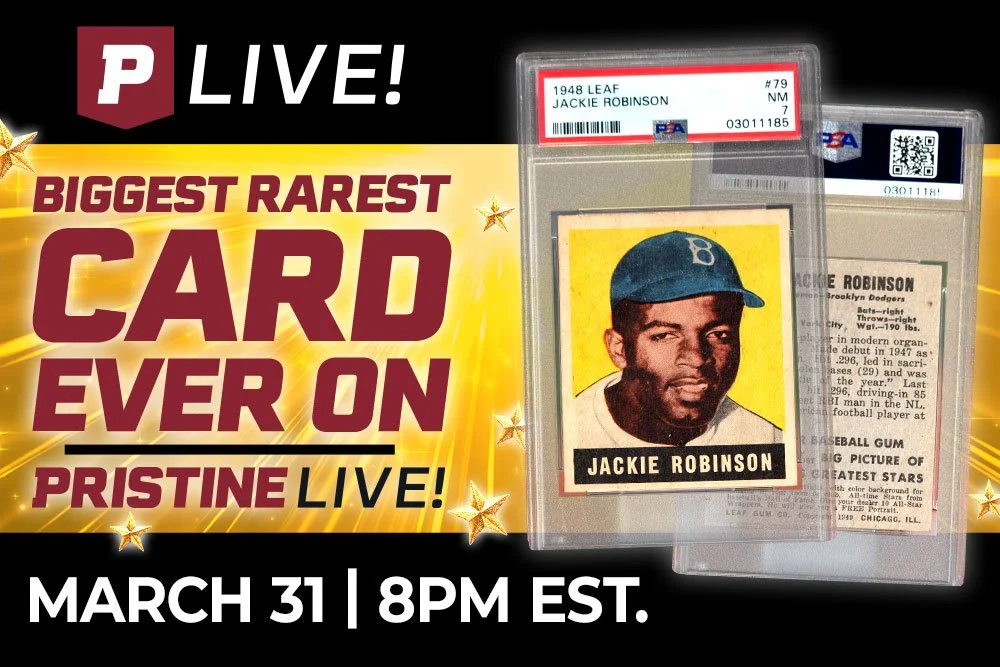
Check out the listing!
Are Jackie Robinson Rookie Cards Undervalued? Market Trends and Scarcity Explained
Here’s one more interesting tidbit about Jackie Robinson cards: some experts are now saying Jackie Robinson cards may still be undervalued compared to the cards of other all-time greats.
It’s not because the demand isn’t there. The belief is the market hasn’t yet adjusted to the true rarity that exists with these cards.
In other words, collectors have yet to realize how few Jackie Robinson cards actually exist from his playing days. It’s not many in comparison to other coveted cards.
An article by Sports Illustrated titled "Understanding Why Jackie Robinson Cards Could Have the Highest Growth Rate in 2026," pointed out something that may surprise you: only eight different mainstream cards were ever released of Jackie Robinson during his playing days.
Even if you include regional issues and non-traditional releases, the total number of cards produced during his playing career is only 13.
Now compare this to someone like Mickey Mantle, who appeared on 247 different cards during his playing days. This includes multiplayer cards, inserts, and oddball issues. Even if you stick with his mainstream releases, he still had 21 regular issue cards during his career compared with Robinson’s eight.
The main reason for this is that, due to segregation, Robinson didn’t enter the MLB until he was already 28 years old. His major league career was shorter, and card production in the late 1940s and early 1950s was far more limited than it would become later that decade.
So, fewer seasons and fewer card sets meant fewer Jackie Robinson cards were produced. This impacts card demand and value, especially for a player like Robinson. And according to SI, this leaves a lot of room for growth in the Jackie Robinson card market.
Why the 1948 Leaf Jackie Robinson Rookie Card Is a True Centerpiece Asset (aka The Mona Lisa Effect)
Some sports cards are simply meant to be a centerpiece — that card you build around, that gets asked about most, that causes friends and acquaintances to pull out their phones for a picture, and that becomes the face of your entire collection.
This is the Mona Lisa effect, and it’s the ideal position for a card like the 1948 Leaf #79 Jackie Robinson. Owning a card like this doesn’t just elevate a collection — it defines it.
Considering the history of the man on the card, the complicated and important set it came from, the well-documented rarity of high-grade examples, and the continued demand for Jackie Robinson cards across the hobby, it’s not hard to understand why this card has become one of the cornerstones of the vintage baseball card world.
Cards like this don’t change hands very often, and when they do, people in the hobby usually take notice.
On Tuesday, March 31, the 1948 Leaf #79 Jackie Robinson rookie card will be sold on Pristine Live! And you can’t miss it! For collectors who’ve been waiting for the right centerpiece card. On March 31, this card won’t sit behind glass — it will be in play. And when the bidding starts, there won’t be another chance to step in.